
There is an old Italian saying that was once repeated so often it became something close to fact: “What’s good for Fiat is good for Italy.” For most of the twentieth century, that was not an exaggeration. At its peak, Fiat under Gianni Agnelli controlled 4.4% of Italy’s GDP, 3.1% of its industrial workforce, and 16.5% of its industrial investment in research. Wikipedia The man behind those numbers was not just an industrialist — he was a king without a crown, running a dynasty that had quietly woven itself into the fabric of an entire nation.
The Agnelli family story is one of the great dynastic narratives of the modern world. It stretches from a cavalry officer in 19th-century Piedmont to a global investment empire worth tens of billions today — and it has never been without drama, tragedy, and the kind of boardroom intrigue that makes most family sagas look tame.
The Founder: Giovanni Agnelli and the Birth of Fiat
Giovanni Agnelli was born into an affluent family of landowners in Villar Perosa, just outside Turin, in 1866. A military career was set out for him, and he trained as an officer before attaining the position of cavalry lieutenant. Quartr But the late nineteenth century had other ideas. The automobile was arriving, and Giovanni recognized it immediately for what it was — not a curiosity, but a civilization-altering machine.
In 1899, enthralled by the big innovation of the era, he joined a group of investors to establish Fabbrica Italiana Automobili Torino — Fiat. Fiat’s first factory opened in 1900 and employed 35 individuals. Despite being the junior member of the founding group, Giovanni’s contributions quickly propelled him to the leading position. Quartr By 1910, Fiat was Italy’s largest automaker. By 1920, Giovanni was its chairman.
What followed was a period of breathtaking expansion — and moral complexity. Giovanni acquired a significant stake in La Stampa, one of Italy’s main newspapers published in Turin, and gained ownership of the Juventus football club in 1923. He created his own bank, enabling people to purchase his cars on credit, and founded IFI in 1927, a holding company he controlled — now known as Exor. Corpwatchers
The darker chapters of the founding era cannot be ignored. In 1914, Agnelli met Benito Mussolini and decided that his car company would finance his political party. When companies like Fiat came under heavy attack for excessive war profits, Mussolini showed his gratitude by wiping the slate clean. Giovanni joined Mussolini’s fascist party in 1932, and when Italy formed an alliance with Nazi Germany, he provided military equipment to the Germans. Corpwatchers As with many great industrial fortunes of that era, the foundations were not spotless.
Giovanni died in December 1945, just fifteen days after losing his daughter-in-law to a car crash — and just months after his possessions had been temporarily seized by Allied authorities. He left an empire in search of a leader.
Gianni Agnelli: The Lawyer, The Legend
The man who would eventually claim that empire was not yet ready for it. Giovanni “Gianni” Agnelli — nicknamed L’Avvocato, “The Lawyer” — inherited control of Fiat in 1966, following a period in which the company was temporarily ruled by manager Vittorio Valletta while he was learning how his family’s business worked. Wikipedia Those intervening years were not wasted. They were spent living.
Gianni Agnelli’s impeccable style and connections with world leaders, artists, and celebrities took his family’s name beyond motorcars, and he became a significant figure in Italian politics and society, helping to shape the country’s direction during a tumultuous period of strikes, terrorism, and protests. Spears Magazine He was photographed with everyone from Jackie Kennedy to the Aga Khan. He was cited as a muse by Ralph Lauren and Tom Ford. He was, in every sense, the prototype of a certain kind of man that the modern world no longer seems to produce.
Gianni was the definition of sprezzatura — the seemingly effortless art of dressing impeccably. He took unprecedented fashion risks like pairing a sharp, double-breasted suit with distressed combat boots. His friends say that he always added a studied carefree touch to an elegant look, like wearing his tie slightly off center. Each outfit was completed with a classic watch worn over his cuff — one of his most imitated style quirks. Italy Segreta
That watch detail has become the stuff of legend. Graydon Carter, the former Vanity Fair editor who made an HBO documentary simply titled Agnelli, says the whole thing was purely practical: “He was one of the first people to wear these gigantic steel watches, and it was simply too large to fit under the cuff — it wasn’t a style thing.” The Gentlemans Journal And yet it became one of the most copied gestures in the history of men’s fashion. That was the Agnelli paradox: everything he did without thinking became something others obsessed over.
Beneath the glamour was a genuinely formidable business mind. Under his leadership, Fiat expanded globally, acquiring stakes in Ferrari, Lancia, Alfa Romeo, and Maserati, and becoming a major player in the global motor industry. Spears Magazine He steered the company through Italy’s turbulent postwar decades, through labor unrest and oil crises, through terrorism and recession, and emerged on the other side with the family’s position strengthened rather than diminished.
One observer said of him: “Much-loved, very imitated, but never equaled.” A Million Steps That was Gianni Agnelli to a sentence.
Tragedy, Succession, and the Elkann Generation
For all its power, the Agnelli dynasty has never been far from grief. Agnelli’s father, Edoardo, died when Gianni was just fourteen — decapitated by a propeller after his seaplane capsized. The Gentlemans Journal His mother died in a car crash fifteen days before his grandfather. His brother Giorgio was diagnosed with schizophrenia and died in a Swiss clinic at 35. And then came the succession crisis that would define the family’s modern chapter.
Gianni’s first choice as heir had been his nephew Giovanni Alberto Agnelli — educated at Brown University, fluent in multiple languages, and already running the family’s motorcycle firm, Piaggio. He was widely admired. Thececilygroup He died of cancer in 1997.
With his preferred successor gone, Gianni turned to his grandson John Elkann — the son of his daughter Margherita and her husband, French-Italian intellectual Alain Elkann. John, still in his early twenties, was quiet, analytical, and disciplined — traits Gianni prized. He began grooming him personally, introducing him to Fiat board meetings and senior executives. Thececilygroup
The decision was deliberate and consequential. Gianni began formalising the family’s holdings into a governance structure that could function like an institution rather than a clan. At its core stood Exor N.V., now a €35 billion investment company controlling Stellantis, Ferrari, Juventus, and other assets. Thececilygroup
But the restructuring came at a personal cost. Gianni’s daughter Margherita was effectively excluded from leadership. In 2004, she sold her 37.5% stake in Dicembre S.A. to her children — John, Lapo, and Ginevra Elkann — for about €1.2 billion, formally transferring control to the Elkann branch. Thececilygroup Decades later, that decision remains bitterly contested. Margherita has since pursued legal action against her own children, alleging she was misled about the true value of what she signed away.
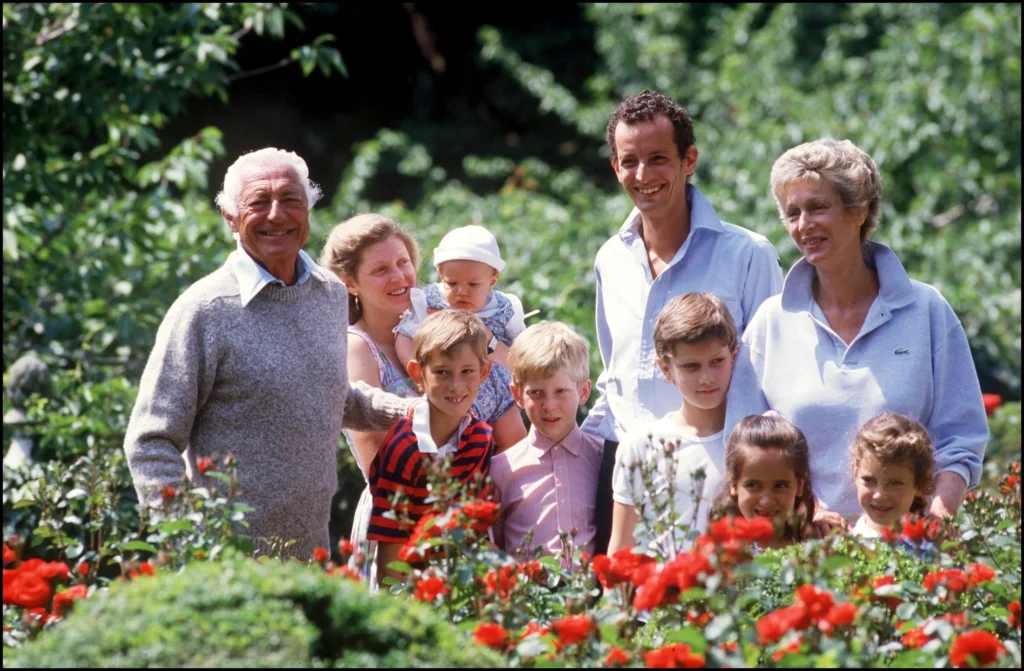
The Empire Today
John Elkann now sits at the center of one of Europe’s most diversified dynastic fortunes. He is the CEO of Exor, an investment company controlled by the Agnelli family, which controls Stellantis, CNH Industrial, Ferrari, Juventus FC, Cushman & Wakefield, and the Economist Group. Wikipedia
The automotive holdings alone are staggering. Stellantis, established in 2021 after Fiat Chrysler Automobiles and Groupe PSA merged, encompasses brands including Abarth, Alfa Romeo, Chrysler, Citroën, Dodge, DS, Fiat, Jeep, Lancia, Maserati, Opel, Peugeot, Ram, and Vauxhall. Wikipedia
Beyond cars, the family’s reach extends into media — they own over 47% of The Economist Group Wikipedia — into real estate, insurance, and technology. The original holding structure that Giovanni founded in 1927 has evolved across a century into something that looks less like a family business and more like a sovereign wealth fund with a human face.
The Agnelli family’s ownership of Juventus, which began in 1923, represents the longest uninterrupted ownership of a sports franchise in the world. EXOR That single fact, perhaps more than any balance sheet figure, captures something essential about this family: they do not simply build things. They keep them.
Notable Heirs
John Elkann — Chairman of Ferrari, CEO of Exor, and the steward of the entire Agnelli inheritance. Married into the Borromeo family — one of Italy’s oldest aristocratic houses — he is deliberate, press-shy, and universally regarded as the architect of the family’s 21st-century reinvention.
Lapo Elkann — John’s younger brother and Italy’s most flamboyant heir. A style icon in his own right, Lapo has founded luxury brand Italia Independent and survived a series of very public personal scandals with his reputation for style, if not sobriety, largely intact.
Ginevra Elkann — The quietest of the three Elkann siblings, Ginevra is a film producer whose work has earned critical recognition across Europe.
Edoardo Agnelli — Gianni’s son and the most tragic figure in the family’s modern history. He converted to Islam, distanced himself from the family, and in 2000 was found dead beneath a bridge near Turin. His family arranged a swift burial, waiving an autopsy, which sparked rumors ranging from suicide to Mafia involvement — questions that have never been fully resolved. Calcali Tech
A Dynasty Built on More Than Metal
What separates the Agnellis from other great industrial families is not simply the scale of their fortune — it is the cultural weight they carry. Gianni Agnelli seems to glow brightly even twenty years after his death. The last two decades have not always been good to the good life. Paparazzi killed discretion. Algorithms outsourced personal style. And rich people nowadays are almost always entirely ghastly. The Gentlemans Journal Against that backdrop, the Agnelli legend only grows.
They are sometimes called the Kennedys of Italy — glamorous, powerful, cursed with tragedy, and utterly impossible to ignore. But that comparison undersells them. The Kennedys had a generation. The Agnellis have had a century, and they are still at the table.
What began with a cavalry officer who fell in love with the automobile in 1899 is now a global holding empire worth tens of billions, with fingers in everything from electric vehicles to literary journalism. The name has changed — Elkann is now the operating surname at the center — but the bloodline and the ambition are entirely continuous.
In a world that has largely traded old money for new noise, the Agnellis remain something rarer: a family that built something real, held it together through tragedy and scandal, and never once stopped looking like they were born to it.
 Author